Email / Phone: soe@bolgatu.edu.gh | +233 24 422 9324
Welcome to the Department of Electrical & Electronics Engineering
excellence in electrical, electronics and renewable energy education, research and innovation for sustainable national development.
Welcome to the Department of Electrical and Electronics Engineering at Bolgatanga Technical University. The Department is a vibrant academic community dedicated to producing skilled, forward-thinking graduates ready to contribute to Ghana’s industrial and technological advancement.
As a cornerstone of innovation and technology in the university, we offer programmes designed to meet national and international needs and global technological standards in electrical power systems, electronics and renewable energy technologies with a special interest in green hydrogen. Our dedicated faculty members, well equipped laboratories and strong industrial linkages ensure a dynamic learning environment that blends academic excellence with practical training.
Vision:
To be a beacon of excellence in electrical, electronics and renewable energy education, research and innovation for sustainable national development.
Mission
- To deliver career-focused, practical training in electrical, electronics and renewable energy disciplines.
- To cultivate industry ready graduates with ethical and technical competencies.
- To promote applied research that supports national energy goals.
- To strengthen linkages with industry and communities through outreach and innovation.
- To nurture entrepreneurial thinking that extends beyond the classroom, equipping students to create self-employment opportunities and contribute to job creation in the power and energy sector.
Objectives:
- Train students to become competent electrical and renewable energy professionals.
- Promote research and clean energy technologies and sustainable electrical systems.
- Engage students in innovative design thinking and practical problem-solving.
- Support local and national development through consultancy and outreach.
Laboratory Infrastructure Development
- Establishment of a Smart Energy Innovation Lab and Green Hydrogen Demonstration Lab
- Expansion of Solar PV Installation and Testing facility Under the Sustainable Energy Centre
Research and Innovation Agenda
- Deployment of smart agricultural solutions using IoT and remote sensing
- Collaborate with institutions to develop an energy efficiency framework tailored for public institutions across northern Ghana
- Collaborate on climate-resilient energy systems through regional and international research grants
Industry and Community Engagement
Strengthening of partnerships for student internships, industry-led projects and co-supervised theses.
Hosting of annual Innovation forum to showcase outstanding student and faculty work, foster collaboration and attract industry participation
Organizing industry seminars and guest lectures to bridge the gap between academic learning and real-world engineering practice
Enhancing knowledge exchange with industry through technical consultancy services and applied research collaborations
The Department offers a range of industry aligned programmes that provide both theoretical foundations and hands-on practical experience. These programmes are designed to meet the growing demand for skilled professionals in electrical engineering, electronics and renewable energy systems.
Bachelor’s Degree Programmes (4-Year)
- Bachelor of Science in Electrical and Electronics Engineering (Regular and Weekends)
- Bachelor of Technology in Renewable Energy Engineering (Regular)
Top-Up Degree Programmes (2-Year)
For HND holders looking to upgrade their qualifications.
- Bachelor of Science in Electrical and Electronics Engineering (Top-Up)
- Bachelor of Technology in Renewable Energy Engineering (Top-Up)
Top-Up Degree Programmes (3-Year)
For Diploma holders looking to upgrade their qualifications.
- Bachelor of Science in Electrical and Electronics Engineering (Top-Up)
- Bachelor of Technology in Renewable Energy Engineering (Top-Up)
Higher National Diploma (HND)
- HND in Electrical and Electronics Engineering (3-Year –Regular)
Diploma Programmes (2-Year –Regular)
Entry-level qualifications designed for foundational technical training
- Diploma in Electrical and Electronics Engineering
- Diploma in Renewable Energy Engineering
Research Focus and Key Achievements
Our department is actively involved in applied research and practical projects in areas including:
- Smart irrigation with IoT for sustainable agriculture
- Solar Photovoltaic (PV) performance studies
- IoT-based remote monitoring and control system
- Smart automation and fault detection
- Power electronics for motor drives and renewable energy application
- Smart metering and electronic instrumentation systems
- Hybrid energy design and simulation
- Design and optimization of analog and digital circuits
- Modelling and simulation of a control system using MATLAB/Simulink
- Industrial Process control using PLC and SCADA
- Embedded systems with microcontrollers
Key Achievements Include:
- Student-led innovations in practical electrical, electronic automation and energy solutions including:
- Smart IoT integrated irrigation systems,
- Solar-powered cooker, solar dryer
- Smart notice board for campus communication
- Smart gas detection and safety alert system
- Smart home alarm system
- Soil nutrients analyzer
- Egg incubator
- Participated in national TVET and engineering competitions.
Professional training and certification delivered through the department’s Sustainable Energy Centre (SEC) in areas such as:
- Design and installation of solar Photovoltaic (PV) systems
- Design and installation of solar-powered water pumping and irrigation systems
Future Programmes and Activities
As part of its growth and strategic direction, the department is committed to expanding its impact through innovative programmes and activities. Upcoming plans include:
Planned Academic Programmes
- MEng. Electrical and Electronics Engineering
Designed to deepen technical expertise in power systems, automation, control engineering, embedded systems, and advanced electronics applications
- MEng. Renewable Energy Engineering
Focused on research and advanced design in solar, wind, bioenergy, and hybrid renewable systems with a special interest in green hydrogen technologies. This programme would support the growing demand for sustainable energy professionals and contribute to the national and global energy transition and climate resilience agenda.
- Diploma in Automation and Control Systems
Entry-level Programme targeting skills in industrial control, PLCs, and IoT applications.
- Diploma in Measurement and Instrumentation
Entry-level Programme targeting skills in industrial control, PLCs, and IoT applications.
- Short Courses in Emerging Technologies
Modular training in areas such as IoT, embedded systems, electrical wiring and installation, energy management, electrical vehicles (EV) technologies, green hydrogen technologies, measurement and instrumentation, and applications
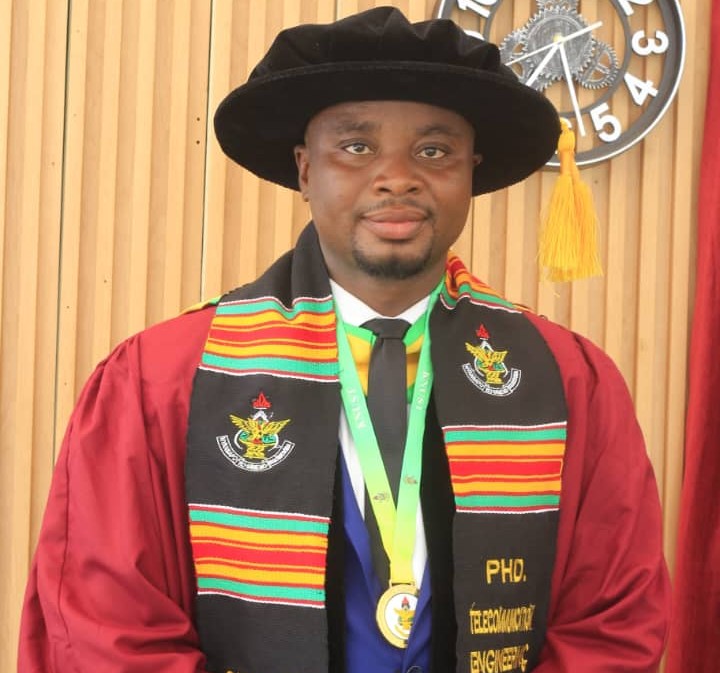
Ing. Raymond Gyaang
Lecturer & Ag. Head of Department (Electrical/ Electronic Engimeering)
Ing. Ryamond Gyaang
Lecturer
Brief Biography:
Selected Publications:
Gyaang Raymond has been a lecturer in the Department of Electrical/Electronic Engineering since August 2021. He received his BSc. Degree in Computer Science and Engineering from the University of Mines and Technology, Tarkwa in 2014 and did his compulsory National service at Yendi Municipal Hospital before joining the National Board for Professional and Technician Examinations (NAPTEX) as an assistant computer Specialist. He received a Korean Professorship Scholarship to undertake a postgraduate programme in Mobile Convergence Engineering at Hanbat National University in Daejeon, South Korea. He returned in 2021 to join the Department of Electrical/Electronic Engineering and subsequently went further to obtain a PhD in Telecommunication Engineering from the Kwame Nkrumah University of Science and Technology in 2025, under the KNUST Engineering Education Project (KEEP) scholarship program, where he was a beneficiary. He has been teaching mainly telecommunication and computer engineering courses to undergraduate students at the University. His teaching includes courses in Electromagnetic Fields Theory, Electromagnetic Compatibility, Radio Receivers, Telecommunication Circuits, Microwave Engineering and Information Theory, Python programming, Computational Tools for Engineers, etc. He is currently the acting head of department of the electrical/electronic engineering department. Ing. Gyaang’s research interests include: Analogue and RF/Microwave Integrated Circuits Six-Port Noise Analysis Artificial Intelligence applications in microwave engineering Deep Neural Network–based RF and Microwave Circuit Design His blend of multidisciplinary research and dedicated teaching enriches both academic and scientific communities.
Selected Publications:
- Gyaang, R., Abdul-Rahman, A., Mubarak, E. S., Kwakye, K. S. O., Gyasi, K. O., & Gookyi, D. N. A. (2025). Analysis and Design of a Six-Port Network Based on a Modified Schiffman Phase Shifter . AFRICAN JOURNAL OF APPLIED RESEARCH, 11(1), 622–640. https://doi.org/10.26437/ajar.v11i1.872
- Gyaang, R., Abdul-Rahman, A., Mubarak, E. S., Kwakye, K. S. O., Gyasi, K. O., & Gookyi, D. N. A. (2025). Analysis and Design of a Six-Port Network Based on a Modified Schiffman Phase Shifter. African Journal of Applied Research, 11(1), 622-640.
- Nounyah, J. A. D., Pormaa, B. A., Mensah, E., Ahmed, A. R., & Gyaang, R. (2025). Design of a Class AB Power Amplifier For 5G Applications. Vokasi Unesa Bulletin of Engineering, Technology and Applied Science, 2(2), 252-269.
- Gookyi, D. A. N., Wulnye, F. A., Arthur, E. A. E., Ahiadormey, R. K., Agyemang, J. O., Agyekum, K. O. B. O., & Gyaang, R. (2024). TinyML for smart agriculture: Comparative analysis of TinyML platforms and practical deployment for maize leaf disease identification. Smart Agricultural Technology, 8, 100490.
- Gookyi, D. A. N., Wulnye, F. A., Ahiadormey, R. K., Wilson, M., Barimah, Y. T., & Danquah, P. (2024, October). Power Efficient Non-Mechanical Weather Station: Harnessing TinyML for Rainfall Classification and Environmental Sensing. In 2024 IEEE 9th International Conference on Adaptive Science and Technology (ICAST) (Vol. 9, pp. 1-7). IEEE.
- Zhao, D., He, J., Jing, X., & Hou, X. (2024, November). DNN performance optimization based on Gemmini neural network hardware accelerator. In Fourth International Conference on Advanced Algorithms and Neural Networks (AANN 2024) (Vol. 13416, pp. 249-255). SPIE.
- Phone:+223-208348720
- Email:rgyaang@bolgatu.edu.gh


Engr. Patrick Appiah
Chief Instructor
Educational Qualification
Brief Biography
- PhD Candidate in Construction Technology, AAMUSTED, Kumasi, Ongoing
- PhD. In Sustainable Energy Engineering and Management. University of Energy and Natural Resources (UENR) Sunyani- Ghana. 2025 to date.
- M. Tech. in Electrical and Electronics Engineering, University of Education, Winneba, Ghana. 2019
- B. Ed Technology Education, University of Education, Winneba, 2007.
- BSc. In Electrical and Electronics Technology education, University of Education, Winneba, Ghana. 2017
Brief Biography
Jefferey Asumda
Assistant Lecturer
- Phone:+233-559919039 / +233-50915986
- Email:dawongo@bolgatu.edu.gh
Samuel Dodobatia Wejetiga
Assistant Lecturer
- Phone:+233556393988/ +233208234400
- Email:akasikaatua@gmail.com
Ing. Philip Asaah
Assistant lecturer
EDUCATIONAL QUALIFICATIONS:
AREAS OF EXPERTISE:
BRIEF BIOGRAPHY:
Selected Publications
Notable Achievements or Ongoing Research Projects:
- Master of Engineering (MEng), Electrical Engineering & Automation – Nanjing Tech University, PR – China, 2019
- Higher National Diploma (HND), Electrical/Electronic Engineering – Sunyani Technical University, Sunyani – Ghana, 2006.
AREAS OF EXPERTISE:
- Electrical Power systems
- Digital and power Electronics
- Smart Grid Control and Integration
- Renewable Engineering Energy
- Engineering Software: MatLab, PVSyst, etc.
BRIEF BIOGRAPHY:
Ing. Asaah Philip, PE-GhIE is a Ghanaian electrical engineer, lecturer, and renewable energy specialist with extensive experience in power systems, broadcasting technology, and automation. He holds a Master of Engineering in Electrical Engineering & Automation from Nanjing Tech University, China, where he specialized in renewable energy and smart grid control systems. Ing. Asaah has dedicated over a decade to the Ghana Broadcasting Corporation, where he served as Head of Engineering, overseeing transmission systems, power management, and technical operations. Beyond his professional career, Ing. Asaah is passionate about youth development and community service, having served as a youth leader and executive member of Geera Energy Co. Ltd, advocating for renewable energy solutions. He is a member of the Ghana Institution of Engineering (GhIE) and has contributed to scholarly research in wind energy optimization and power systems. With expertise in electrical engineering, Ing. Asaah continues to drive innovation in renewable energy and broadcasting technology while mentoring the next generation of engineers.
Professional Affiliations- Member of Professional Engineers of Ghana Institution of Engineering (GhIE), 2022 – Date
- Member of Association of Energy Professionals – Ghana (AEP-Gh), April, 2025 - Date
Selected Publications
- Philip Asaah, L. Hao and J. Ji, "Optimal Placement of Wind Turbines in Wind Farm Layout Using Particle Swarm Optimization," in Journal of Modern Power Systems and Clean Energy, vol. 9, no. 2, pp. 367-375, March 2021, DOI: 10.35833/ MPCE.2019.000087.
- L. Hao, J. Ji, D. Xie, H. Wang, W. Li and Philip Asaah, "Scenario-based Unit Commitment Optimization for Power System with Large-scale Wind Power Participating in Primary Frequency Regulation," in Journal of Modern Power Systems and Clean Energy, vol. 8, no. 6, pp. 1259-1267, November 2020, DOI: 10.35833/ MPCE.2019.000418
- Philip, Asaah, Yushuo Zhang, Lili Hao, Yantong Zhou, and Wei Li. "Analysis and Suppression Strategy of Sub-synchronous Oscillation for Wind-Thermal-Bundled Power Transmitted by Series-Compensated System." In Proceedings of PURPLE MOUNTAIN FORUM 2019-International Forum on Smart Grid Protection and Control, pp. 3-12. Springer, Singapore, 2020. https://doi.org/10.1007/978-981-13-9783-7_1
- Shu-Feng, Guo, Zhang Jie-Tan, Asaah Philip, Hao Li-Li, and Ji Jing. "A Review of Wind Turbine Deloaded Operation Techniques for Primary Frequency Control in Power System." In 2018 China International Conference on Electricity Distribution (CICED), pp. 63-71. IEEE, 2018. DOI: 10.1109/CICED.2018.8592549
Notable Achievements or Ongoing Research Projects:
- Nanjing Tech University’s Scholarship, PR – China, 2016 – 2019
- Jiangsu Provincial Scholarship, PR – China, 2017
- Phone: +233 246283929 and +233 205219961
- Email:pasaah@bolgatu.edu.gh
Sufyan Yakubu
Assistant lecturer
EDUCATIONAL QUALIFICATIONS:
AREAS OF EXPERTISE
Authomobile Engineering
BRIEF BIOGRAPHY:
Selected Publications:
- MSc. in Energy Engineering, Abou Bekr Belkaid University -Tlemcen, Algeria, 2023
- BSc. in Renewable Energy Engineering, University of Energy and Natural Resources, Sunyani, Ghana, 2018
AREAS OF EXPERTISE
Authomobile Engineering
BRIEF BIOGRAPHY:
Sufyan Yakubu is a dedicated academic and practitioner in the field of sustainable energy with particular focus on decentralized energy, solar photovoltaic, hybrid energy and floating PV. He has collaborated with leading experts and institutions, advancing knowledge in energy efficiency and conservation, floating PV, Solar PV efficiency, decentralized blockchain energy trading and hybrid energy systems. He is the co-author of multiple peer-reviewed publications, including chapters in international energy books and journals. His research on "Comparative performance evaluation of ground-mounted and floating solar PV systems" has been particularly influential, driving innovation in floats design modifications in floating PV application. He also actively involved in teaching and leadership further contributing to the academic and professional community.
Selected Publications:
- Yakubu, S., Tedla, T. S., Gawusu, S., Wetajega, S. D., Josue, M. M., Alhassan, N., & Workneh, G. A. (2025). Hybrid energy system as driver of sustainable rural development: An optimization and impact analysis of Tulefa Energy Village, Ethiopia. Energy Nexus, 18(October 2024), 100434. https://doi.org/10.1016/j.nexus.2025.100434
- Yakubu, S., Samikannu, R., Yahya, A., Anjum, I., Kamangar, S., Begam, M., Kwarteng, M., Santino, N., Ladu, D., & Dodobatia, S. (2025). Results in Engineering Feasibility design, comparative evaluation, and energy consumption prediction of standalone hybrid energy system for rural electrification in Ghana using machine learning models. Results in Engineering, 25(February), 104269. https://doi.org/10.1016/j.rineng.2025.104269
- Solahudeen Tando, M., Gawusu, S., Yakubu, S., Kwabena, O. S., Donatus, D., & Raqib Abu, S. (2025). Decentralized energy trading with blockchain technology. The Intersection of Blockchain and Energy Trading: Exploring Decentralized Solutions for Next-Generation Energy Markets, 75–101. https://doi.org/10.1016/B978-0-443-23627-3.00004-1
- Dzamesi, S. K. A., Ahiataku-Togobo, W., Yakubu, S., Acheampong, P., Kwarteng, M., Samikannu, R., & Azeave, E. (2024). Comparative performance evaluation of ground mounted and floating solar PV systems. Energy for Sustainable Development, 80(March), 101421. https://doi.org/10.1016/j.esd.2024.101421
- Gawusu, S., Zhang, X., Yakubu, S., Kofi, S., Das, O., & Singh, N. (2025). Optimizing solar photovoltaic system performance: Insights and strategies for enhanced efficiency.319(February). https://doi.org/10.1016/j.energy.2025.135099
- Yakubu, S., Abdulai, A. S., Maclar, M., Atta, F., Paskwali, T., Latio, B., Santino, N., & Ladu, D. (2024). Potential of Energy Efficiency and Conservation Measures in Residential Buildings in Ghana (Case Study of Student Hostel). 1(4), 23–41. https://doi.org/10.14302/issn.2642
- Yakubu, S., Samikannu, R., Gawusu, S., Dodobatia, S., Okai, V., Shaibu, A. S., & Adam, G. (2025). A holistic review of the effects of dust buildup on solar photovoltaic panel efficiency. Solar Compass, 13(October 2024), 100101. https://doi.org/10.1016/j.solcom.2024.100101
- Yakubu, S., Samikannu, R., Lydia, J., Vimalraj, L. S., Karpagam, R., & Yahya, A. (2023). Exploring the Progress of Decentralized Photovoltaic Systems in Rural Ghana: A Comprehensive Review. 2023 IEEE Renewable Energy and Sustainable E-Mobility Conference, RESEM 2023, 1–6. https://doi.org/10.1109/RESEM57584.2023.10236139
- Phone:+233 24 168 76 92
- Email:syakubu@bolgatu.edu.gh
Christopher Dabire Naya
Senior Instructor
EDUCATIONAL QUALIFICATIONS:
RECOGNITION, AWARDS, AND PROFESSIONAL ENGAGEMENTS:
AREAS OF INTEREST AND SPECIALIZATION
PROFESSIONAL EXPERIENCE
An experienced electrical and electronics engineer with a strong academic foundation in applied engineering. He holds a Bachelor of Technology in Electrical and Electronic Engineering and a Higher National Diploma (HND) from Sunyani Technical University. Currently advancing his academic pursuits through postgraduate studies in Electrical Power Systems Engineering (MPhil) at Kwame Nkrumah University of Science and Technology (KNUST)
RECOGNITION, AWARDS, AND PROFESSIONAL ENGAGEMENTS:
- DTU Skylab - Next Generation Digital Action (NGDA), Denmark – participant in a global summit on digital innovation and sustainability (2024)
- IEEE Power & Energy Society Project Competition, India – participant with outstanding project presentation (2022)
- WorldSkills Future Skills Camp (IoT Track), Russia – selected as a competitor in the prestigious international IoT training program (2020)
- Certified Participant, Arduino & Sensor Interfacing Workshop, STU (2021)
AREAS OF INTEREST AND SPECIALIZATION
- Embedded Systems and Microcontroller Programming
- Internet of Things (IoT) and Smart Automation
- Artificial Intelligence and Machine Learning
- Renewable Energy Systems (Photovoltaics, Smart Irrigation)
- Real-time Prototyping and Human-Centered Engineering Solution
PROFESSIONAL EXPERIENCE
- Teaching Assistant, Sunyani Technical University – facilitating tutorials, grading, and student mentoring.
- President, Lithium Technologies Limited – leading innovation in embedded systems training, prototyping, and renewable energy projects
- Industry experience with VRA/NEDCO and Wuduyas Electricals – offering practical exposure in utility operations, fault diagnosis, and electrical installations.
- Phone: +233 554390510
- Email:cnaya@bolgatu.edu.gh
eee@bolgatu.edu.gh
Phone
+23302656666945
Location
Library Complex